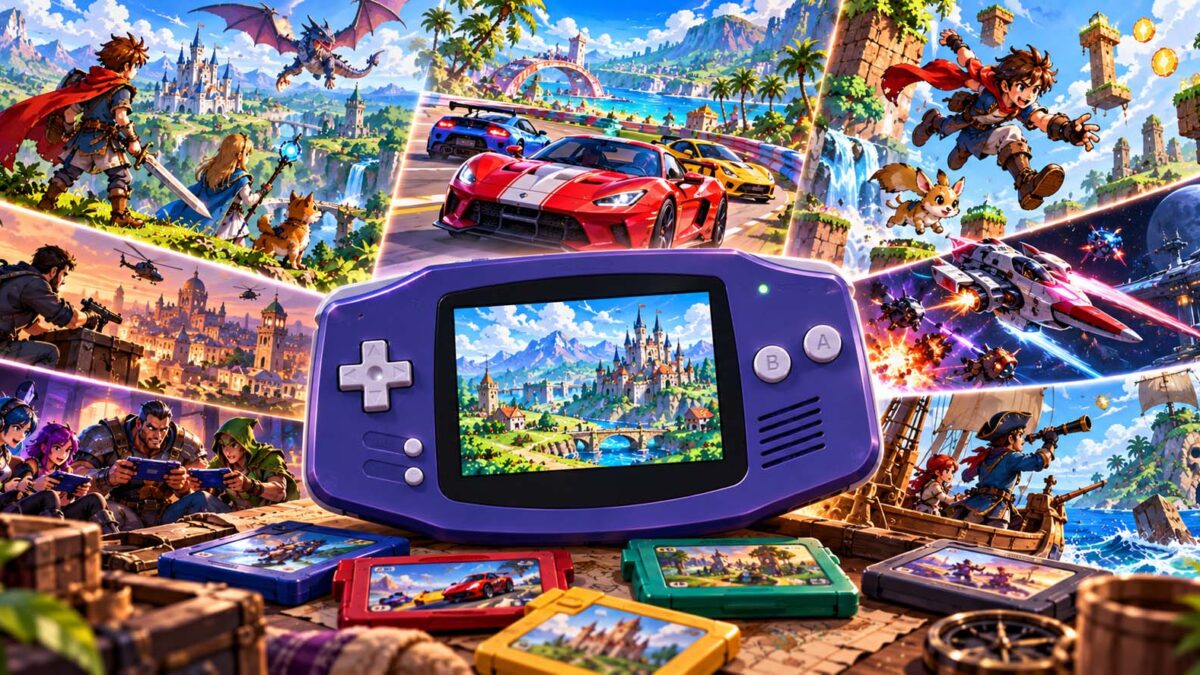
Licensed GBA games are often associated with movie, television, comic, and other entertainment franchises, but the quality of these adaptations varied considerably. While some relied heavily on familiar branding, others offered enjoyable platforming, action, racing, exploration, or puzzle mechanics that could stand on their own as handheld experiences.
For retro players, that makes licensed games worth judging individually. A recognizable franchise can attract attention, but gameplay ultimately determines whether an adaptation remains enjoyable after the novelty of the license wears off.
What Are Licensed GBA Games?
A licensed game uses characters, settings, stories, or other intellectual property from an existing entertainment franchise.
During the Game Boy Advance era, these adaptations could draw from animated series, movies, superheroes, children’s entertainment, and other established properties.
The license gave developers a ready-made world and audience. However, adapting that material to handheld hardware required design decisions that could significantly affect the final experience.
A console game might emphasize 3D environments, for example, while a GBA version could reinterpret the same property as a 2D platformer, action game, puzzle experience, or another format better suited to the handheld.
As a result, portable adaptations sometimes differed substantially from versions released on other systems.
Why Licensed GBA Games Developed a Mixed Reputation
Licensed games can face an unusual design challenge.
Players expect recognizable characters and themes, but those elements alone do not create satisfying gameplay. Developers still need responsive controls, sensible difficulty, clear objectives, useful progression, and well-designed levels.
When those fundamentals are weak, familiar branding cannot completely solve the problem.
Another challenge comes from expectations.
Fans may want a game to reproduce the experience of a movie or television series closely. Yet directly copying scenes does not always produce interesting interactive design.
The stronger adaptations tend to use the source material as a foundation while still considering what works as a video game.
A Good Adaptation Needs More Than a Famous Name
Brand recognition can encourage someone to try a game, but it rarely explains why they continue playing.
Strong licensed GBA games need mechanics that remain enjoyable even when separated from the franchise attached to them.
For a platformer, that might mean responsive movement and varied stages. An action game needs combat that feels understandable and rewarding. Racing adaptations require controls and course design that make repeated play enjoyable.
This provides a useful test for any licensed title: would the core gameplay still be interesting if the recognizable characters were replaced?
If the answer is yes, the adaptation probably has something meaningful to offer beyond its branding.
Handheld Limitations Could Encourage Creative Adaptations
The Game Boy Advance could not simply reproduce every experience available on more powerful home consoles.
That limitation could encourage developers to reinterpret a franchise rather than directly imitate another version.
A large 3D adventure might become a side-scrolling game. Complex cinematic action could be translated into shorter stages. Other adaptations could use puzzles, racing, exploration, or simplified combat to fit the strengths of portable hardware.
These changes were not automatically disadvantages.
When developers designed around the capabilities of the GBA, the handheld version could develop its own identity. In some cases, players may find the portable interpretation interesting precisely because it approaches familiar material differently.
Gameplay Should Come Before Franchise Loyalty
Fans naturally approach licensed games with expectations shaped by the original property.
However, retro players looking for enjoyable handheld experiences should evaluate the game itself.
Useful questions include:
- Are the controls responsive?
- Does the difficulty feel reasonable?
- Are stages varied enough to remain interesting?
- Does progression provide meaningful rewards?
- Do the mechanics suit short handheld sessions?
- Is there enough variety to avoid repetitive play?
These questions help separate the quality of the game from feelings about the franchise.
Someone comparing broader GBA game recommendations can use the same criteria for licensed adaptations and original handheld titles rather than assuming one category is automatically stronger.
Licensed Games Can Introduce Players to Different Genres
A familiar franchise can sometimes act as an entry point into a genre a player would not otherwise choose.
Someone interested in a particular animated property might try a platformer because it features recognizable characters. A movie fan might encounter racing, action, puzzles, or exploration through an adaptation.
If the gameplay succeeds, the player may discover an interest that extends beyond the original license.
This gives licensed games an interesting role in handheld libraries. They do not only translate existing entertainment into interactive form; they can also connect audiences with different styles of gameplay.
Why Some Licensed Titles Become Overlooked
Reputation can influence retro discovery.
If players broadly assume that licensed games are weaker than original titles, they may skip unfamiliar adaptations without examining their individual qualities.
Major first-party releases and famous franchises also dominate many retrospective discussions. That leaves less room for games associated with temporary movie releases, television properties, or entertainment brands that no longer receive the same attention.
As a result, a competent adaptation can disappear from common recommendation lists even when its gameplay remains enjoyable.
This does not mean every overlooked licensed game is a hidden gem. It simply means obscurity should not replace evaluation.
How Should Retro Players Evaluate a Licensed GBA Game?
Start with the same criteria used for any other game.
Consider the controls, level design, pacing, challenge, variety, visual clarity, replay value, and overall gameplay loop.
Then consider how effectively the game uses its license.
Recognizable characters and environments can strengthen the experience when they complement the mechanics. They become less valuable when the game relies on them as substitutes for interesting design.
It also helps to separate nostalgia from playability.
A title connected to a childhood movie or television show may have personal value. That is a legitimate reason to revisit it, but modern players can still ask whether the mechanics remain enjoyable today.
Both perspectives can exist together.
Are Licensed GBA Games Worth Playing Today?
Some certainly can be, depending on the player’s preferences and the quality of the individual adaptation.
The important point is to avoid treating “licensed game” as a quality rating.
Licensing describes where the characters, setting, or intellectual property came from. It does not tell players whether the controls are responsive, the levels are creative, or the gameplay has enough variety.
Retro gaming becomes more interesting when titles are evaluated on what they actually offer rather than on broad assumptions about their category.
Looking Beyond the License
The Game Boy Advance library included many types of games, and franchise adaptations were part of that variety. Some were designed primarily around recognizable properties, while others used the limitations and strengths of handheld hardware to create more distinctive experiences.
A familiar character or movie connection may be what first attracts a player, but lasting enjoyment usually depends on mechanics, pacing, level design, and replayability.
For that reason, licensed GBA games deserve to be considered individually. Looking beyond the logo can reveal adaptations with creative ideas and enjoyable gameplay while helping retro players judge each title by the experience it actually provides.


