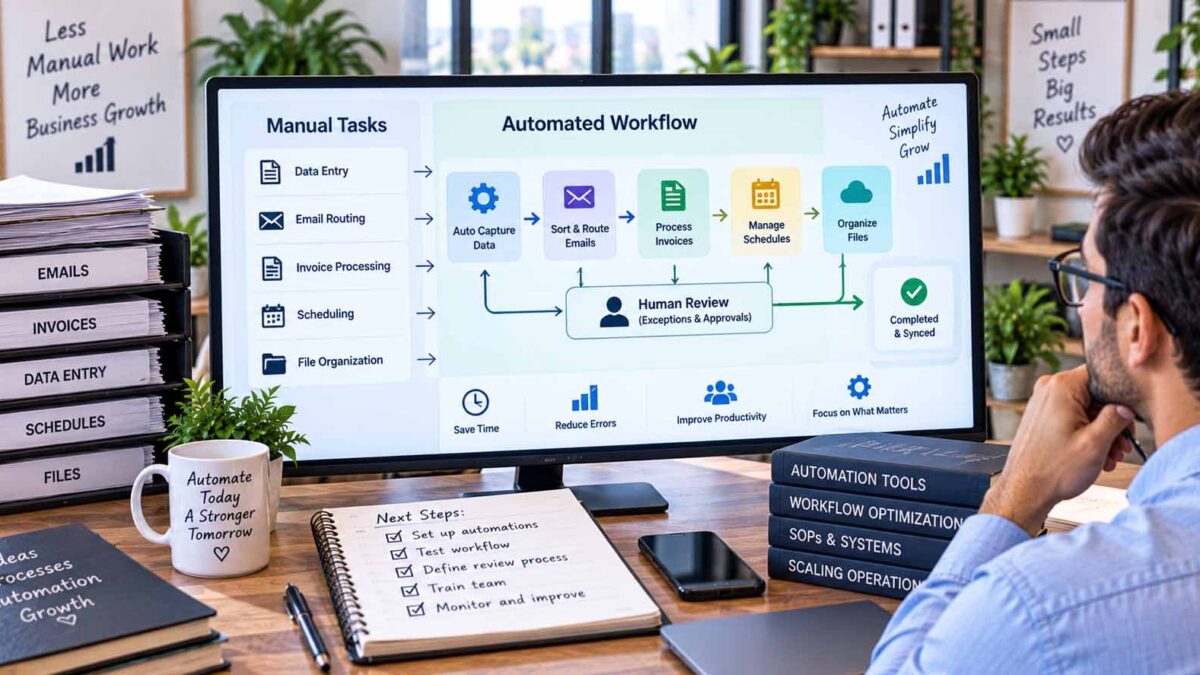
The best way to automate repetitive business tasks is to identify work that happens frequently, follows predictable rules, uses structured information, and requires little judgment during normal execution. Tasks such as transferring data between systems, sending routine notifications, organizing files, scheduling recurring activities, or updating records may be good candidates when automation can reduce manual effort without creating unnecessary complexity.
However, repetition alone does not make a process suitable for automation. Businesses should first understand how the task works and where human judgment remains important.
Start by Finding Work That Repeats
A practical automation review begins with recurring activities.
Look at the tasks employees perform every day, week, or month. Pay particular attention to work involving the same sequence of clicks, data entry, notifications, file movements, or status updates.
Examples might include:
- Copying information between applications
- Sending standard confirmation messages
- Creating recurring reports
- Updating customer records
- Routing forms to the correct person
- Renaming and organizing files
- Scheduling routine reminders
- Recording recurring transactions
The goal is not to automate all of these immediately. Instead, the list creates a starting point for evaluating where automation could provide meaningful value.
Look for Clear Rules and Predictable Inputs
Tasks are easier to automate when they follow consistent rules.
Consider a simple form-routing process. If requests in one category always go to a particular team member, software can potentially apply that rule automatically.
By contrast, a task requiring someone to interpret unusual circumstances, negotiate with a customer, or make a strategic decision may not fit a rigid automated workflow.
When evaluating a process, ask:
What starts the task?
What information does it require?
Which rules determine the next action?
What should happen when the process finishes?
What exceptions require human attention?
Clear answers make it easier to determine whether the workflow is predictable enough for automation.
Automate Repetitive Business Tasks That Consume Meaningful Time
Frequency matters, but so does effort.
A task performed once per month for two minutes may not justify building and maintaining an automated process.
Meanwhile, a five-minute activity repeated many times throughout the week could consume substantial staff attention over time.
Businesses should therefore consider both frequency and manual effort.
Automation is most useful when the time saved, improved consistency, or reduced administrative burden justifies the setup and ongoing maintenance required.
Check Whether the Process Is Stable First
Automating a poorly designed process can simply make an inefficient workflow operate faster.
Before introducing automation, examine whether every step is actually necessary.
A workflow may contain duplicate data entry, unnecessary approvals, outdated forms, or manual transfers that exist only because two systems were never properly connected.
Simplifying the process first can reduce the amount of automation needed.
Businesses examining workflow improvement, operational systems, software, and related management topics can check over here through GrowBizLab for broader small-business information.
Once the underlying process is clear, automation can focus on the steps that genuinely need to happen.
Identify Tasks With Structured Data
Automation generally works more reliably when information follows a consistent format.
For example, a standardized online form with defined fields is easier for a system to process than an unstructured message containing several different requests.
Structured inputs can include:
- Form fields
- Spreadsheet columns
- Database records
- Standard invoice information
- Calendar events
- Defined status categories
If employees regularly need to interpret ambiguous information before taking action, complete automation may be inappropriate.
In those situations, automation can sometimes handle the predictable portion while leaving interpretation to a person.
Pay Attention to Error-Prone Manual Transfers
Manual data transfer is worth examining because repeated copying and re-entering of information can create opportunities for mistakes.
Suppose customer information arrives through a form and an employee manually copies it into another business system.
If compatible tools can transfer that information automatically, the company may be able to remove a repetitive step.
However, automation should still include appropriate validation.
Moving incorrect information automatically does not make it correct. The workflow should account for missing fields, invalid formats, duplicate records, and other foreseeable exceptions.
Decide Where Human Review Still Matters
Good automation does not require removing people from every stage.
Some workflows benefit from a combination of automated processing and human approval.
Software might collect information, organize it, prepare a draft, or notify the responsible employee. A person can then review the result before a consequential action occurs.
Human review may be particularly useful when a process involves financial commitments, sensitive customer issues, unusual exceptions, quality judgments, or decisions with significant business consequences.
The objective is to remove unnecessary manual work while preserving judgment where it adds value.
Estimate the Cost of Automation
Automation has costs of its own.
Software subscriptions, integrations, setup time, testing, employee training, monitoring, and maintenance should all be considered.
A complicated automation designed to save a small amount of time may create more work than it removes.
Businesses should also consider what happens if the workflow fails.
If an automated process is operationally important, someone should know how to identify failures, correct errors, and complete the task manually when necessary.
Test One Workflow Before Expanding
A small pilot can reveal whether an automation works as expected.
Choose a clearly defined repetitive process and document how it currently works. Then automate the predictable steps and monitor the results.
Check whether the workflow saves time, produces accurate outputs, handles common exceptions, and remains understandable to the employees responsible for it.
If the pilot works, similar processes can be evaluated next.
If it creates new problems, adjust the workflow before expanding automation further.
Automation Should Make Work Simpler
The purpose of business automation is not to use technology everywhere. It is to reduce unnecessary manual effort while keeping processes reliable and manageable.
The strongest candidates are usually repetitive, rule-based, stable, and supported by structured information. They also consume enough time or create enough administrative friction to justify automation.
By reviewing recurring work systematically, simplifying processes first, and preserving human oversight where necessary, a small business can automate useful tasks without turning a straightforward workflow into a complicated technology project.